Not too long ago, I came across this article about a biologist who happened to scoop up some pond water in a jar, just because. Looking at drops of it in her microscope, she was surprised to see a specimen of a rare and unusual protozoa – one that just might turn out to be a new species.
My mind went back decades to my own youth, when I had my own “pond in a jar” for a while. I don’t remember what motivated me to make one, but I enjoyed watching water fleas swimming, a hydra anchored to the side of the jar, and even a little freshwater clam doing its thing in the muck at the bottom.
I thought, “There’s a pond near me with a shallow area at one spot, and a good amount of plant life in it. I’ve jot the jar, why not make another one?”
I made sure I scooped up some muck from the bottom, and a scummy mass of algae from the surface. I grabbed a little sprig of Elodea (a common water plant), just in case.
When everything settled down the next day, I counted six little diving beetles. The water was greenish; I’m guessing that was from microscopic algae. There were quite a few little swimming dots – “copepods” – of different sorts. All of the plant matter was floating at the top.
A few days later, I could see at most three diving beetles – maybe six was too many for the jar? The Elodea sprig seemed to be getting longer, so that was good. I could divide the tiny swimmers according to color – greenish, bluish, and brownish. The water was getting clearer, too.
Reading about these jars online suggested that it takes about a week for them to “stabilize”. After about a week, I could see teeny snails, and a plant of some sort had sprouted in the muck at the bottom. Occasionally I’d see a worm-like creature swimming around, but never the same type twice. Perhaps the predatory diving beetles were eating them.
The biggest incident happened on Day 17. Turning the jar to get a better look at what was going on inside it caused the mass of plant / algae floating at the top to slowly sink to the bottom. Well, almost the bottom. Perhaps I jostled it just so, or given the warm spell that was going on at the time, something about the density of the water changed just enough….. Anyway, the Elodea was obviously bigger / longer. A few of the snails had grown to the point where I could start seeing patterns on the shells.
A day or so after that, I could count five diving beetles (I rarely see more than two, though). They are tiny, not much bigger than sesame seeds, and with yellow(ish) and black markings. The sprouting plant has six leaves, and is getting bigger. There seem to be fewer of the teeny swimming things.
Here’s a photo of the jar on Day 20:
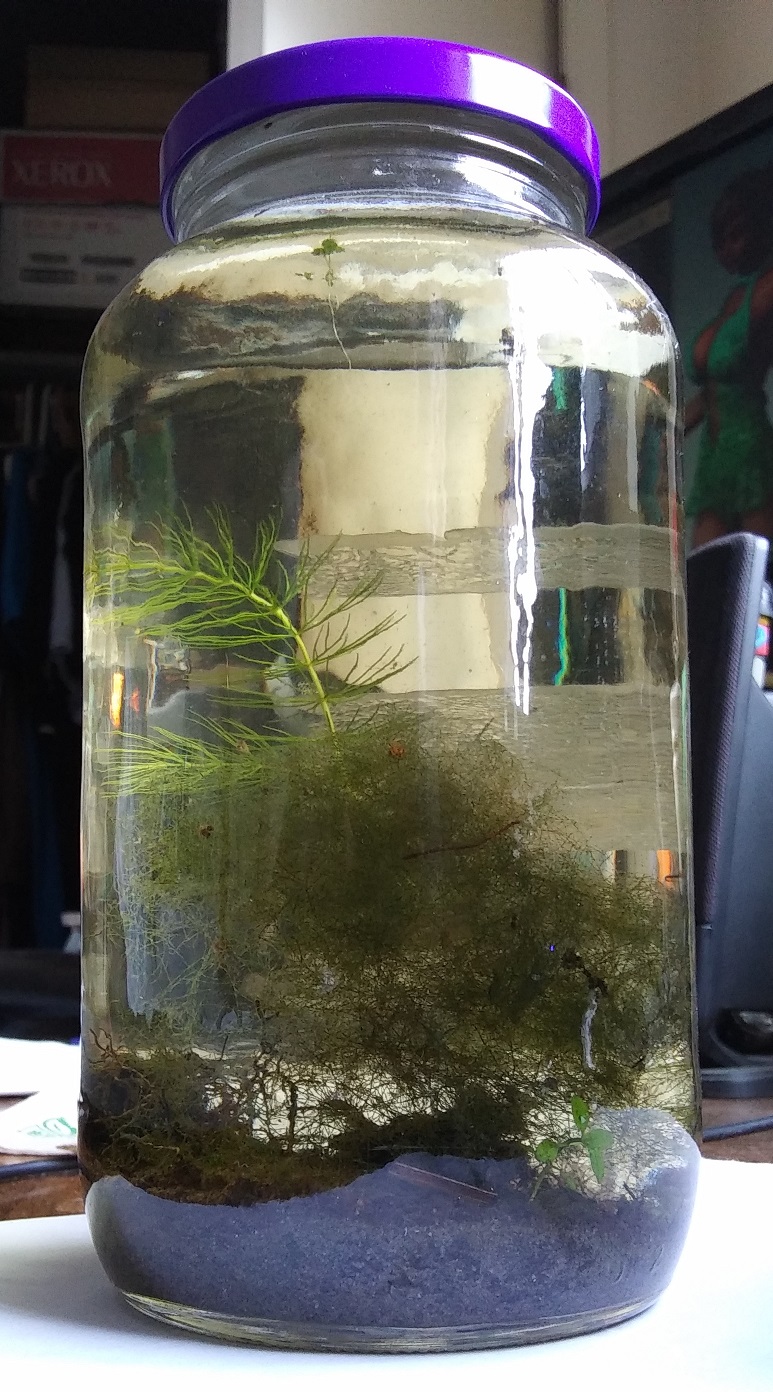
Hey, it’s my cheap phone camera, OK?
There are fewer creatures that I can see, and the Elodea is about twice as big as it was originally. Maybe if I put it in a shadier area…. It’s difficult to resist opening the jar to poke around….
Anyway, if you want to have your own, it’s not hard at all – provided there’s a decent freshwater pond in your area.
Get a clean glass jar, of at least 16 ounces in capacity. Pasta sauce jars are perfect. If you have to use soap, let the jar dry out for a few days so any residue can go away. Remove the label, too. Keep the lid.
Go to your local pond, and find a spot where the water isn’t too deep at the shoreline, and plants can be seen growing in the water. Scoop up muck, water, and plants. You’ll want around one half to one inch of muck, and some plants. If you can snag some pond scum, do that, too. Fill the jar almost all the way. Close up the jar, and wipe off the outside. No need to be carrying dirt and scum back with you.
Put the jar where it can get some sunlight, but not too much direct sun. You don’t want to overheat the thing. Wait, and watch often.
Some sources say you should poke a teeny hole in the jar lid, and then seal it with beeswax. Apparently, the idea is to allow for any gases that build up to escape, but to minimize evaporation. In addition to wondering why you’re supposed to seal the hole that you just made, isn’t the idea here to make a self-sustaining sealed environment? Eh, whatever….
If your Pond in a Jar fails, dump the contents back where you got them. Most likely, though, your jar will find a safe and steady balance.
It’s also possible (so I read) to make a saltwater Pond in a Jar, if you’ve got a salt marsh near you. I might try that one out later.
Oh, if you don’t have one, get a magnifying glass to help you see all the things going on in there. Even a small one helps.
I’ll update this if things warrant.


Pingback: Pond in a Jar – 7 | Pure Blather