This is Dinant:

You have now seen Dinant.
What, you want more? Oh, alright then…..
Dinant is a city on the banks of the Meuse or Maas River (depending on the language of your maps). The high cliff means it’s pretty much a long strip of a city. It – and the bridge – date back to the Roman times. It’s undergone a LOT of rebuilding after being heavily damaged in both World Wars.
The statue of Charles de Gaulle honors him for his role helping to defend the city in the Battle of Dinant in August 1914. The Citadel at the top of the cliff dates to 1815, where it replaced an 11th century castle. You can take a cable car up to check it out, or test your endurance on the 400+ step staircase. The big church is the Collegiate Church of Our Lady; it dates back to the 13th century and has some large and lovely stained glass. The saxophones on the bridge? They are there because Dinant is the birthplace of Adolphe Sax; its inventor.
There are excursion boats a-plenty that ply the river in the area; it’s supposed to be quite lovely on a sunny day.
Dinant was basically a rest stop; the real destination of my day trip was Luxembourg City, the capital of one of the smallest countries in the world.
It used to be significantly bigger, but stuck between France, Germany, and the Netherlands, it kept losing territory while being passed around between the three. Even when Belgium got its independence from the Netherlands, they still kept family ties with the Dutch royal family. Anyway, in order to forestall the possibility of a war between France and Prussia, it was agreed to essentially let them be left to their own devices.
Why all the fuss over that little bit of land? The heart of the capital city is a plateau on a massive rocky outcrop. A medieval fortress there dominated the area’s trade routes, earning it the name “The Gibraltar of the North”.
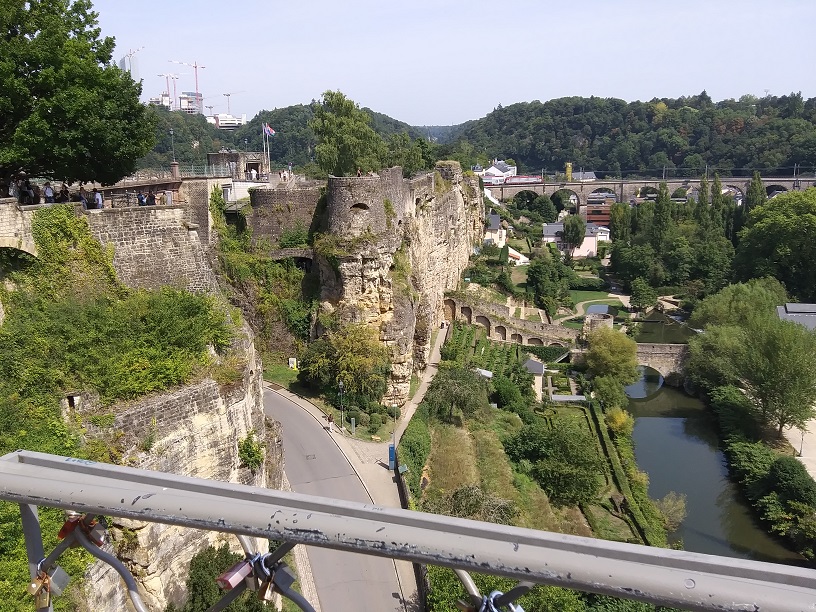
A UNESCO World Heritage Site
And they are quite happy to be independent; the national motto (taken from an 1859 patriotic poem) as seen here is “We want to stay what we are”.

The “Monkey’s Bar” on the Rue de la Loge
These days, being conveniently located and having no problematic history, Luxembourg City is one of the three capitals of the European Union. Government administration is probably one of the major industries in the country.
After our tour, we were allowed to spend a good bit of time exploring the place. They’ve got lovely and impressive monuments for their war dead. I couldn’t get a good photo of Gëlle Fra, the “Golden Lady” (official name: The Monument of Remembrance) who honors those who lost their lives volunteering for the Allies in WWI. In this photo from the lower walkway of the Adolphe Bridge, she’s on the plateau on the left.

If I wanted a better view of the monument, I’d be floating in the air.
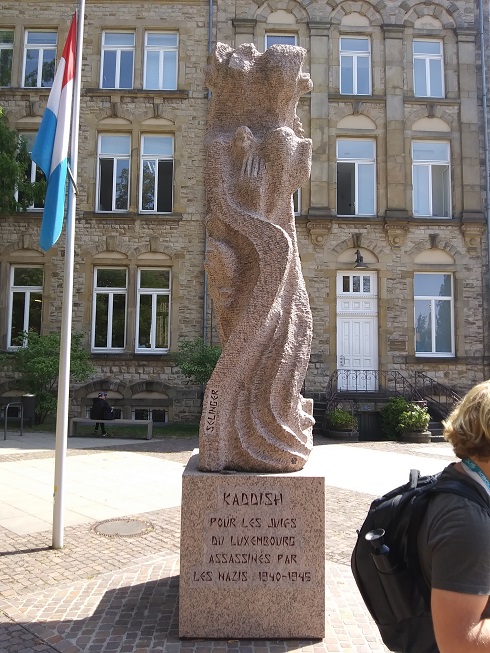
This is a side view (the side with the English inscription) of their monument to their Jews killed by the Nazis:
To end things on a nicer note, there’s a fine “central park” (the “Place d’Armes”) surrounded by restaurants (even a Burger King – ugh), shops, and a government building. The main shopping street has all the same names you’d see in any upscale shopping district – Louis Vuitton, Cartier, Gucci…. The country is still a Grand Duchy (“We want to stay what we are”), and apparently gets a lot of revenue from the EU people who live and work there. Enough to make ALL mass transit in the country completely free. Well, to be fair, it’s not like there’s that much of a demand for it….
Still, though, I loved the place. I want to retire there, if they’ll have me.
Next time – two of the things Belgium is best known for, in one walking tour.
 Pure Blather