Welp, time to take a walking tour and learn about the history of Brussels. I booked a tour online through Viator, but it doesn’t seem like you need to do that. Just get to the Grand-Place / Grote Markt (Brussels’ main square) early enough, and look for someone carrying a brightly colored umbrella with a flag on the top. They’re a tour leader, and the flag indicates the language of the tour. I don’t think they care if you tag along; a lot of the umbrellas say “Free Tour”, and there’s no sign that they check people at the start. Just show up and tag along. At least I didn’t pay much for my tour.
Anyway, there’s not much in the way of very old history in the area. The country didn’t exist until 1830, even though the city – like a lot of them in the country – goes back much further. Stuff happens when you are constantly being fought over…..

One of the few remnants of Medieval Brussels still extant.
Almost all the buildings in the Grand-Place are from the 1690s. In one of his many wars of expansion, Louis XIV of France had his troops bombard the city. The Town Hall on the west side of the square was one of the few stone buildings in the place – and its tower, being the tallest, was used as the aiming point for the French artillery. So the commander had his gunners leave the Tower alone…. The wooden buildings were wiped out, and even the Town Hall took damage. When the fires were put out and the debris cleared, the guilds of the town decided to rebuild everything. Took only a couple of years. Even with the many buildings to put up and different guilds sponsoring things, there’s still a great unity of look and style.

The south side of The Grote Markt
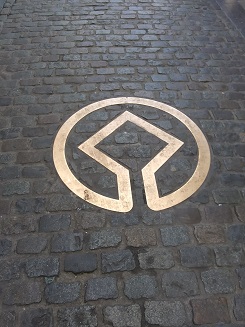
That’s largely why the place was named one of UNESCO’s World Heritage sites (after it got a thorough cleaning, restoration, and touching-up; it had been allowed to deteriorate over the decades) – and why this symbol is in the streets at the entrance of the Grand-Place:
We ambled through the narrow and winding streets, passing a number of Locations of Interest, like the Palace of Justice. OK, we didn’t actually stop there, but we got close enough to get a good view of what the locals refer to as the “Museum of Scaffolding”. A couple of decades ago, Brussels decided that the world’s largest courthouse needed a full-scale renovation of the exterior. A company was hired, they put up scaffolding, and then went out of business – leaving the scaffolding in place. It was allowed to deteriorate to the point where the scaffolding needed repairing and renovation. Well, things are getting taken care of now, and they intend to be done in time for Belgium’s bicentennial in 2030.
Eventually we made our way to the “Square du Petit Sablon” (i.e. Little Sablon Park). It’s a beautiful park / formal garden, surrounded by statues representing the 48 guilds that have been based in the city, and statues of Belgian notables. There’s also a grand fountain with a statue of Counts Egmont and Hoorne, whose refusal to “follow the Party line” with King Philip II of Spain led to their execution – the start of the Netherlands Revolt. And yes, he’s the Egmont of the Egmont Overture.
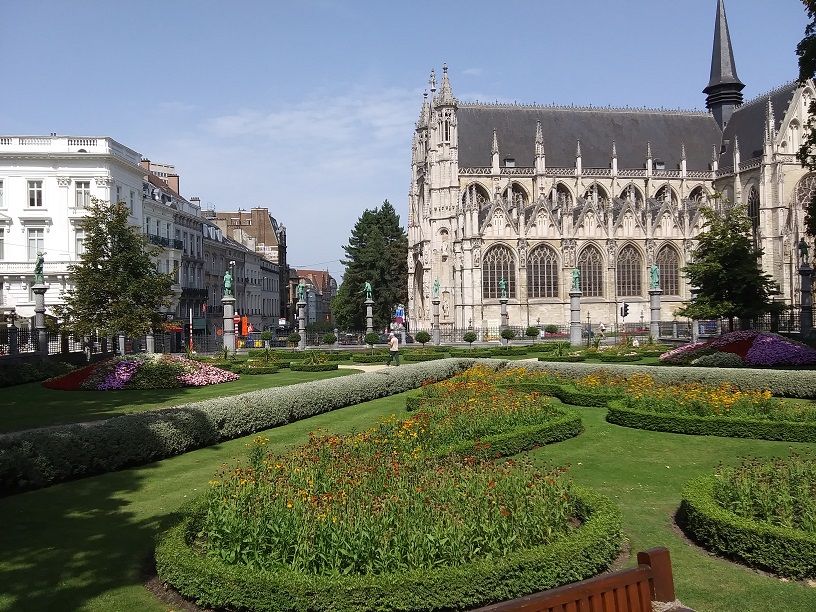
That’s the Church of Our Lady of Victories at the Sablon on the right
Heading back to the center of town, we walked through the Mont des Arts, the location of most of the museums you’d want to see – the Magritte Museum, the Royal Library and Archives (the KBR Musuem), the Royal Museum of Fine Arts, the Museum of Musical Instruments (more on that later)…. And a few government buildings to make the place even more impressive. There’s also a nice park.
What’s really interesting about the history is that there’s virtually nothing about WWII. No visible monuments, nothing in the presentations or even the city history museum. They go right from the nation’s centennial in 1930 to the International Exposition in 1935 to the World’s Fair of 1958 and the creation of the European Economic Community (now the EU). (shrug)
Next time, I get the heck out of town and visit Dinant and Luxembourg.
 Pure Blather