Some more notables that have gone on to their rewards, and were probably overlooked in the usual year-end summaries. Or if they weren’t, they deserve another salute anyway.
WALLY AMOS (1936-2024):
Born in Tallahassee FL, his parents divorced when he was 12, and he moved to Harlem to live with his aunt Della. He was inspired by her baking skills and started training for a culinary career. During apprenticeships in high school, he complained that White students seemed to have better opportunities, so he dropped out to join the Air Force in 1954, spending most of his four-year service in Hawaii.
He moved back to New York and landed a mailroom job at the William Morris talent agency. In 1961, he became a junior agent, the first Black employee to hold that job at the agency and among the first in the country. He helped with tour arrangements for singers such as Marvin Gaye and groups including the Supremes and Simon & Garfunkel. He left in 1967 to start an agency in Los Angeles.
To ease the stress of launching a new agency, he started baking cookies (using a recipe he learned from his aunt Delia) and shared them with clients. As his talent agency struggled, Mr. Amos wondered if his cookies were a financial option. “Friends would see me and before even saying ‘hello,’ they would say, ‘Hey man, where are my cookies?’” he recounted.
If the cookie business failed, he could always go back to representing musicians and actors, he figured. He pulled together $25,000 using connections from his time in New York. The grand opening of “Famous Amos Cookies” in March 1975 was a block party that drew more than 1,500 people to what he called a “seedy” stretch of Sunset Boulevard that included a strip club across the street from the shop. Above the door of the shop was a giant image of a cookie and Mr. Amos. He built an image as the jester of the snack aisle — with his playful banter, Panama hats and wild shirts with a kazoo tucked in the pocket. “This is show business. I know it,” he told the New York Times in August 1975, five months after he opened, as people lined up to buy cookies by the pound at his shop on Sunset Boulevard in Hollywood.
As the brand grew, he struggled with the transition from colorful founder to business-attuned chief. Profits sagged, and the luster of the brand began to fade. He would sell off all his interest in the company by 1988. “I got ahead of my team. I forgot there was a team,” he recounted. “I thought that because I was famous Amos … I had all the answers, but I was very, very wrong. And that ultimately caused me to lose Famous Amos.”
He was also a passionate local activist battling childhood illiteracy — noting that his mother had not learned to read when she was young. Each Saturday at a shop in Honolulu (where he kept a spare room with dozens of donated children’s books), Mr. Amos put on a watermelon-print hat and sat in a rocking chair, reading to children who surrounded him. He was presented a National Literacy Award by President George H.W. Bush in 1991.
“Your greatest contribution to your country is not your signature straw hat in the Smithsonian but the people you have inspired to learn to read,” Bush said.
Amos in 2007:

ROGER CORMAN (1926-2024):
While trying to start a career in acting, Jack Nicholson was working as an office boy at MGM when Corman spotted him. Other actors who owe their careers to Corman movies include Robert De Niro and Sylvester Stallone.
Corman asked the UCLA film school to send over a top student to help him edit a bunch of Russian science fiction films he’d just acquired. They sent over Francis Ford Coppola. Martin Scorsese and Jonathan Demme are among the many directors who also got their starts with Corman.
The kid who made the spaceship models for Battle Beyond the Stars did so good a job that Corman named him Art Director for the film – it was James Cameron’s first screen credit.
Famous for turning out films on minimal budgets and incredibly fast shooting schedules (Little Shop of Horrors was conceived, written, and filmed in a few days – because there was a set availabe that was about to be torn down), Corman once said he did not object to enormous budgets, if the money was spent for a good reason. “When I see Jim Cameron spending $150 million on Titanic, you look at the film and say, ‘Yes, it’s on the screen.’ So I understand what he did and I have no objection,” he told a British Columbia newspaper. “What I do object to is when you have a picture with two people talking in a room and they say it costs $80 million. At that point I say, ‘OK, tell me: Where did the money go?’”
Corman with his Academy Award in 2009 – the Governor’s Award, “for his rich engendering of films and filmmakers.”

“When we did Death Race 2000 in two and a half weeks, it shows you it could be done. It was the only unofficial college of the arts where you got to learn filmmaking for free by a master… If I hadn’t done those parts I probably wouldn’t be here today… He provided a forum for a lot of us to grow. We were the seeds and he owned the farm.” – Sylvester Stallone
JIM DONOVAN (1956-2024):
Baseball announcers seem to get all the glory. Red Barber. Vin Scully. Mel Allen. Harry Caray. Ernie Harwell. But football announcers can have just as much of a passionate fan base and following as any of them.
A graduate of Boston University, Donovan got to Cleveland in 1985. Along with doing local reporting of the city’s three professional sports franchises, Donovan also had several national network assignments and was part of NBC’s coverage team at the 1992 and 1996 Summer Olympics. When the Browns were “reborn” in the city in 1999, WKYC tapped him to be the lead announcer for their coverage.
“He kept it real, but he kept a positive tone to it,” said former Browns kicker Phil Dawson, who inducted Donovan into the team’s Legends Club. “He just always could find that balance — authentic, real, accurate, but he was still supportive, even when there wasn’t a whole lot to support. And I know the players appreciated that. I know I certainly appreciated that. He was always quick to try to provide context rather than letting people just focus on an individual moment. He just really had a knack for seeing the big picture. It was always ‘Go Browns,’ yet he kept it real and accurate so that everybody understood what was going on.”
“I’m watching the greatest show on Earth — Jimmy. He’s got the hand gestures. He’s waving. You’d think he had a chipmunk in his shorts. I mean, he was all over the place. He had moves for everything that was going on down on the field. His gestures were telling the same story that he was reciting.” – Doug Deiken, Donovan’s partner in the booth for 23 years
ARTHUR FROMMER (1929-2024):
Arthur Bernard Frommer was born in Lynchburg, VA, to Jewish immigrants from Eastern Europe. His family moved to Brooklyn when he was 14, and worked as an office boy at Newsweek while attending Erasmus Hall High School, where he edited the school paper. He received a bachelor’s degree in political science in 1950 from New York University. Three years later, he graduated from Yale Law School, where he had been an editor on the law review. After a stint in the Army, he joined the Manhattan office of Paul, Weiss, Rifkind, Wharton & Garrison in 1956.
He could have had a good career in law, but a side project he started while with the Army was starting to take too much of his time. While stationed in Berlin, he noted that too many of his fellow GIs weren’t bothering to travel or even see the sights. They felt it was too expensive for their limited finances. He begged to differ, and spend his weekends traveling and seeing all that he could. In 1955, he self-published the results of his jaunts. The G.I.’s Guide to Travelling in Europe sold out almost immediately. Two years later, Frommer revised the book for the general public and renamed it Europe on 5 Dollars a Day.
He made the leap of faith into travel writing, and left the legal profession in the early 1960s to focus full time on updates to the guide to Europe and on the creation of books on travel to Mexico, Japan, Israel, Ireland, Greece and the Caribbean. By the end of the decade, the Frommer series had become the best-selling line of travel guides ever published.
An army of freelancers wrote his other guides, but Frommer remained the author for newer editions of his maiden book. He personally visited every hotel and restaurant mentioned in his book, resulting in works that were accessible, conversational and always unapologetic.
In 1977, he sold his series to Simon & Schuster but continued to contribute to the texts. His belief that travel was about “self-education” and not mere sightseeing — “We go to Paris; we look at the Eiffel Tower, and we think we’ve traveled” — led to “Arthur Frommer’s New World of Travel,” his series on unconventional tourism. In 2012, he got the series back and printed dozens of new editions under the name Frommer Media.
He never really cared much for the “minimalist” approach used by many who carried his books while backpacking across Europe. “They were traveling cheaply, but passing their days senselessly,” he told the Seattle Times. “That’s not the travel I wanted to support.”
In 2009, the Los Angeles Times asked him if he ever splurged on a five-star hotel. “I once stayed at a super-deluxe place in South Beach, Miami, with Philippe Starck decor and $400 rooms,” he said. “It was so cold I felt like I was living in a refrigerator, and there were no decent lights. I cringe whenever I hear the words ‘boutique hotel.’ Any Courtyard by Marriott is better.”
Frommer in 2015:

FRANÇOISE HARDY (1944-2024):
Born in Paris during an air raid, she was raised by her single mother. At the age of 16, she received a guitar from her largely absent father, and immediately began writing songs. In 1962, she recorded her first single, “Tous les Garçons et les Filles”. The song, which she wrote and composed, quickly became a hit, marking her rise as a key figure in the “yé-yé” movement, a French response to rock ‘n’ roll.
She sang in French, English, Italian and German, and drew admirers from the ranks of the biggest stars in the world. Bob Dylan was among her admirers, addressing her with a poem on the back cover of his early album Another Side of Bob Dylan. When he came to Paris to do his first concert there, Hardy recalled, he refused to return to the stage unless she agreed to meet him.
Her lyrics often captured the angst and longing of adolescence, resonating deeply with young audiences. Her melancholic and introspective tone set her apart from the more exuberant pop music of her peers. This arguably reflected her own personality; she was open in her autobiography and in interviews about her struggles with anxiety, self-doubt, loneliness and inferiority complex.
She resisted both industry intervention and collaboration for its own sake, tending to keep a distance from the male songwriters who lurked in the era’s shadows. Her subsequent early 1970s albums, La Question and Message personnel, were daring and original, cementing her in her own right in the French singer-songwriter canon. In the 1990s, she would collaborate with Blur and Iggy Pop. A lymphoma diagnosis in 2004 slowed her down, but didn’t stop her. Her last album was released in 2018.
In 2023, Rolling Stone magazine ranked Hardy as No. 162 on a ranking of the greatest singers of all time. She was the only French performer on the list. Will Hermes wrote that Hardy “epitomized French cool and Gallic heat simultaneously, with a breathy, deadpan alto that wafted like Gauloises smoke. Her words enhanced her tone: Writing her own material, unusual in the early mid-Sixties, especially for women, she also recorded work by masters like Serge Gainsbourg, and her take on Leonard Cohen’s ‘Suzanne’ may be the most evocative ever recorded, his included.”
Comment te Dire Adieu (It Hurts to Say Goodbye) (by Serge Gainsbourg)
“What I’m looking for is beauty. Beauty in art often comes from sadness. As Alfred de Musset said: The most desperate are the most beautiful songs” – Françoise Hardy
ICQ (1996-2024):
ICQ was among the crop of early instant messenger services, like AOL Instant Messenger or MSN Messenger, that allowed for real-time chats. It differed from others by assigning users a number they would use to connect to one another, as opposed to aliases or email addresses. It also had uncommon features like SMS messaging and the ability to message people who were offline. It also worked across different platforms.
Launched in 1996 by Israeli company Mirabilis, which AOL bought in 1998, it had over 100 million users at its peak. In its heyday, the service was so popular that the original version of Messages for the Mac in 2002, known then as iChat, would allow ICQ’s User Identification Number (UIN) to add AOL Instant Messenger compatibility.
The service was bought out by Mail.Ru in 2010. Users and usage declined as other messaging services took its place. The service was shut down on June 26, 2024.
ICQ had been out of my life for years—decades, even—but I always knew in the back of my mind that it was still out there, quietly thrumming away, doing its thing, a small island of software stability in a great black sea of dead and forgotten software. I even occasionally imagined that I would one day wake up from a deep sleep and holy cow, I remember my password! And I would log back in, one last time, to look at all those friends from so long ago. – Andy Chalik, PC Gamer
A little ditty based on ICQ’s “you have a message” announcement tone:
INGENUITY (2021-2024):
Like so many of NASA and JPL’s creations, it lasted far longer than planned.
After over 70 flights, a short vertical hop was programmed to check the ‘copter’s location. Just before touchdown, contact with the Perseverance rover was lost. When it was re-established, it was discovered that one of Ingenuity’s rotor blades was broken.
Sent as part of the “Mars 2020” mission which included the Perseverance rover, the task for Ingenuity was a simple one: demonstrate the technology to perform flights on another world. On April 19, 2021, the 19-inch tall, 4-pound helicopter became the first powered aircraft to lift off from the surface of another planet.
Only five flights were part of the original mission, but it kept on going, serving as a scout for Perseverance, checking out interesting places to explore and the routes to get to them. The teams at NASA and JPL developed winter operating procedures so that Ingenuity could survive the long cold nights. They upgraded its systems, giving it the ability to choose its own landing sites and even clean itself after dust storms.
GEORGE JOSEPH KRESGE JR. (1935-2024):
Born in Montclair NJ, he started doing magic shows at a young age. The comic strip “Mandrake the Magician”, about a crime-fighting magician, got him interested in the power of the mind. He tried it out – asking his family to hide a penny somewhere in the house for him to find, following only his intuition and what he felt he could pick up from his family’s thoughts and body language. “Nothing worked until one afternoon, my brother hid a penny, and I climbed up on a chair and reached up behind the curtain rod in my grandparents’ bedroom,” he told the Chicago Tribune in 1991, “and there it was.”
He started performing professionally while in high school, earned a bachelor’s degree in psychology from Seton Hall University, and worked for years as a clinical psychologist while also expanding his act. What he learned about psychology and hypnosis worked its way into his shows
He made his TV debut in 1964, on “The Steve Allen Show” – where he tripped and fell flat on his face when he went to shake hands with Allen. The stumble was ‘borrowed’ by Johnny Carson, who debuted his “Carnac” character two months later. Carson would have him on his show many times, and encouraged him to adopt the stage name of “The Amazing Kreskin”.
One of his more famous and frequent stunts was to put his own pay on the line. He had members of the audience hide the check for his appearance. If he couldn’t find it, he forfeited the fee. Mr. Kreskin managed to find hundreds of checks stashed in places such as inside a fire hose or the barrel of a gun.
A film loosely based on Kreskin’s career, The Great Buck Howard (2008), starred John Malkovich as a once-celebrated mentalist struggling to make a comeback with audiences that are harder to wow. (Sean McGinly, who worked for several months as Mr. Kreskin’s road manager, wrote and directed the movie.) He regarded the film as conveying one important point: his belief that the digital age has eroded traditional human interactions. And that, he said, muddied the waters for a mentalist. “People don’t hear each other anymore,” he said. “There are actually human beings, and this is going to seem incredible, who when they’re in a restaurant have a cellphone on the table and they’re looking into it.”
“I make my living off the mind,” he told The Washington Post in 2023. “I’m not a hypnotist, but I know the power of suggestion. I’m not a psychic. I’m not a medium. I can’t tell the past or the future. But I can, most of the time, perceive in some way what people are thinking in the moment.”
On Letterman, 4/3/90:
THOMAS KURTZ (1928-2024):
**** COMMODORE 64 BASIC V2 ****
64K RAM SYSTEM 38911 BASIC BYTES FREE
READY
10 PRINT “Thomas Kurtz”
20 PRINT “Born in Oak Park IL 1928
30 PRINT “Graduated from Knox College in 1950”
40 PRINT “Received Ph.D. in Mathematics from Princeton, 1956”
50 PRINT “Got teaching position at Dartmouth”
60 PRINT “Worked with fellow professor John Kemeny to develop the original version of the Dartmouth Timesharing System (DTSS), a method of sharing computer access across a network”
70 PRINT “Also developed a simple, easy to use and learn computer language that worked with DTSS”
80 PRINT “Unveiled DTSS on May 1, 1964, along with their BASIC computer language”
85 REM B.A.S.I.C. stands for “Beginner’s All-purpose Symbolic Instruction Code”
90 PRINT “Served as the director of the Kiewit Computation Center at Dartmouth and as director of the Office of Academic Computing from 1975 to 1978”
100 PRINT “Joined Kemeny and three former Dartmouth students in forming True BASIC, Inc., whose purpose was to develop quality educational software and a platform-independent BASIC compiler”
110 PRINT “Retired from Dartmouth in 1993”
120 PRINT “Died November 14, 2024”
130 REM “https://computerhistory.org/blog/in-memoriam-thomas-e-kurtz-1928-2024/“
140 FOR X = 1 TO 10
150 PRINT “R.I.P.”
160 NEXT X
170 END
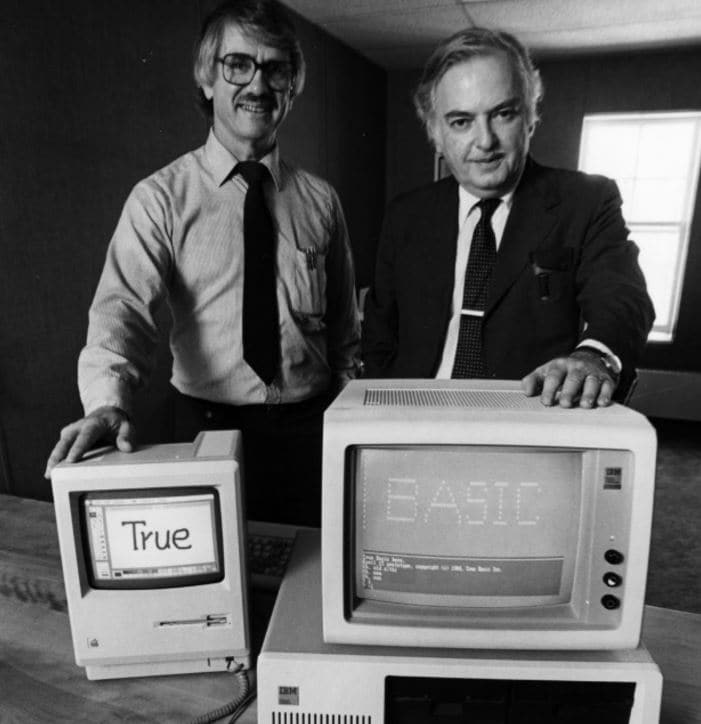
Kurtz (L) and Kemeny, showing off TrueBASIC (date unknown):
PETER MARSHALL (1926-2024):
Born Ralph Pierre LaCock in Huntington WV, his father died when he was 10. As a teenager, he moved to New York City, where his older sister, Joan, was modeling. She became the movie star Joanne Dru, and was married to popular big-band singer Dick Haymes.
He got a job as a page at the NBC studios at Rockefeller Center, studied singing with Haymes, adopted the name Peter Marshall and, at 15, became the “boy singer” with a jazz band led by Bob Chester.
After returning to Huntington to finish school, he was drafted into the Army. He wound up working as a DJ based in Naples; returning to the US, he worked in radio in Florida for a while before moving to California, where he developed a comedy act with Tommy Noonan, and would headline at clubs across the country.
He started getting acting roles in movies and TV and on the stage. He appeared in the 1964 film comedy Ensign Pulver, then had a nearly year-long run in the 1965 Broadway musical Skyscraper, starring Julie Harris. In the musical, he helped introduce the James Van Heusen-Sammy Cahn standard “I’ll Only Miss Her When I Think of Her” and won praise from the New York Daily News as “a very satisfying leading man.”
He was in line to be cast in a musical version of Breakfast at Tiffany’s, which was scheduled to go to Broadway. At the last minute, his part was offered to Richard Chamberlain. Looking for work, he reluctantly agreed to audition for a new TV game show.
Starting in 1966 and running for 15 years, Hollywood Squares became a top-rated staple of daytime television on NBC and later expanded to a popular prime-time version with the same format. It would earn Marshall five Emmy awards. “It was the easiest thing I have ever done in show business,” Mr. Marshall said in a 2010 interview with the Archives of American Television. “No rehearsal. I walked in and said, ‘Hello, stars,’ I read questions and laughed and got paid wonderfully well.”
Five shows — a week’s worth — were typically taped in a single day. Mr. Marshall noted that after the first three tapings, there was a lunch break. When they returned to the set, the guest stars were often tipsy. “Everyone would drink, wine flowed,” Mr. Marshall told The Washington Post in 1985. “The last two shows were hysterical.”
Even when he was on “Hollywood Squares,” Mr. Marshall regularly appeared in theatrical productions, as a guest actor on television and as a singer, primarily in Las Vegas. In the mid-1980s, he had a leading role as Georges in a national touring production of La Cage aux Folles, about the long relationship of two gay men.
he recorded several albums as a singer and published a show business memoir, Backstage With the Original Hollywood Square, in 2000. In the book, he mentioned that, after an episode of Hollywood Squares, he received a threatening letter from actor John Wayne.
One question in the episode claimed that Wayne demanded that his children and grandchildren address him as “Sir.” In a letter, Wayne denied that was true and wrote, “I suggest you correct it on your show or don’t ever pass me on the street.”
“I treasure this letter,” Mr. Marshall later said. “It’s one of my favorite things that I own.”
SEIJI OZAWA (1935-2024):
Being introduced to America on Leonard Bernstein’s “Young People’s Concerts”, 1962:
Being honored at the Kennedy Center, 2015:
PAUL PARKMAN (1932-2024):
Getting his MD from the State University of New York in 1957, he moved to a residency in pediatrics. There, he often gave newborns their first medical examinations. He recalled his sorrow as he once wheeled a bassinet bearing a stillborn baby into the mother’s room so that she could gaze upon her child. The baby had a rash — the likely result, Dr. Parkman realized later, of a rubella infection during the mother’s pregnancy.
In the early 1960s, he served in the Army Medical Corps and was stationed at Fort Dix in NJ. Working on viruses, he got bored with his assigned study of cold viruses, so he started hanging out in a ward that housed recruits suffering from rashes. Many of the young men, Dr. Parkman and his colleagues discovered, had rubella, also known as German measles.
Later, at the Walter Reed Army Institute, he and colleagues isolated and identified the rubella virus. Moving to the National Institutes of Health in 1963, he and colleagues started working on a vaccine just as a massive outbreak hit the US. Some 12.5 million Americans contracted rubella, 11,000 pregnancies ended in miscarriage, 2,100 newborns died, and 20,000 babies were born with the birth defects encapsulated by the term “congenital rubella syndrome.” Doctors had no way of telling how badly an infant would be affected – making the pregnant women face a gut-wrenching choice.
In 1966, Dr. Parkman and Dr. Harry M Meyer Jr. announced their discovery of a safe and effective vaccine against rubella. Other rubella vaccines followed and, in the span of four years, were administered to nearly 40 million American chi|dren. In 1971, a combined measles, mumps and rubella (MMR) vaccine was introduced to protect recipients against three diseases at once.
Rubella was declared eliminated from the United States in 2004.
During his time at NIH, Dr. Parkman became chief of the section on general virology before his department was transferred to the Food and Drug Administration. He rose to lead the FDA’s Center for Biologics Evaluation and Research, where he helped oversee policies on HIV/AIDS testing and treatment, before his retirement in 1990.
“As I look back on my career, I have come to think that perhaps I was involved in the easy part,” he wrote in the publication FDA Consumer in 2002. “It will be for others to take on the difficult task of maintaining the protections that we struggled to achieve. We must prevent the spread of this vaccine nihilism, for if it were to prevail, our successes could be lost.”
Meyer and Parkman (R) examing a culture of rubella viruses, 1967:

WILLIAM “BILL” POST (1927-2024):
Born in Grand Rapids MI, he took a part time job washing trucks for Hekman, a local baking company, at the age of 16. After a stint in the Army, he decided that working at Hekman was more fun than going to college. Taking assorted positions and rising up the ranks, he became a full-time plant manager.
In 1963, he got a call from Kellogg’s. They were trying to compete with Post Cereals, which was planning to launch a breakfast pastry. Post recalled the day that four Kellogg’s executives visited the baking plant with a prototype: a pielike pastry, shaped like a slice of bread, with “fork marks around the edge — two pieces of dough with some filling in it.”
“They said, ‘We have this idea. We’d like to put that in a toaster.’ ”
As he told it, his boss scoffed at the idea. Mr. Post embraced it. “At the time, I thought it was a great idea,” he said in a 2003 interview with Northern Express, a Michigan newspaper. “But as we became more involved, it sort of had to work, because man oh man, I had my neck out so far on the equipment and getting unauthorized shipments of equipment from other facilities without permission and without accounting records, and just plowing through and getting this thing done. In retrospect, we expended hundreds of thousands of dollars, so this thing had to go.”
He realized he had a hit product, he said, when his children kept asking to try more samples of his “fruit scones,” as the pastries were originally called.
The initial test release of “Pop- Tarts” in Cleveland had to be raised from 10,000 to 45,000 cases of the four original flavors (strawberry, blueberry, apple currant, brown sugar cinnamon) to keep up with demand.
The frosting came later, in 1967. Post came up with the idea himself. After running Pop-Tarts through a cookie-icing machine he found that the frosting didn’t melt, and the new glaze was embraced by Kellogg’s executive William E. LaMothe, who instructed him to add frosting to each variety. “We just doubled the market with that one decision made in one day,” he recalled.
Post rose to become a senior vice president at Keebler and spent two decades as a consultant for Kellogg’s. He said he continued to eat three or four Pop-Tarts a week into his 90s and always had a pack on hand in his car, which he emblazoned with a “POPTART” license plate. His favorite: frosted strawberry, untoasted. “I eat them cold,” he told Northern Express, “just the way they are.”
“Two in each packet, two slots in the toaster. There’s no wrong way! Why two? One’s not enough, and three’s too many. And they can’t go stale because they were never fresh.” – Jerry Seinfeld
Bill in 2003:

JIM RISWOLD (1957-2024):
Born in Seattle, he started writing in the fourth grade after a teacher suggested he take a creative writing class. He graduated from the University of Washington in 1983, where he studied philosophy, history and communications. After briefly working as a copywriter in Seattle, he was hired as Wieden+Kennedy’s first copywriter, reporting directly to cofounders Dan Wieden and David Kennedy.
His best work, though, came when the agency landed the Nike account. “The list of clients who have benefited from Jim’s talent is long and deep,” Wieden wrote in 2012. “But all he wants to talk about these days is Nike. This company, this brand was his true calling, his passion, his ticket to the show.”
Bob Wood, a former VP of Marketing at Nike, said Riswold had an ability to harness the idiosyncrasies and oddities of early Nike employees. “A lot of the characters at Nike, nobody would have employed us,” Wood said. But Riswold could take their suggestions – in the form of a creative brief – and elevate them. “He could take all of that and go three steps further,” Wood said, coming up with something “hilarious, but also completely in the zone of what we wanted to do.”
“Bo Knows” (1989)
“It’s Gotta Be the Shoes” (1991)
“Hare Jordan” (1993)
Riswold was diagnosed with leukemia in 2000 and treated by Oregon Health & Science University’s Dr. Brian Druker, the renowned cancer doctor who is now CEO of the Knight Cancer Institute. “What was remarkable about Jim is that if you do a search on him, you realize he created all of the iconic Nike advertisements and he hung out with Michael Jordan and Charles Barkley and Tiger Woods, and he’d never sit around and say, ‘I was hanging out with Michael Jordan,’” Druker said. “He was just a regular guy with a great sense of humor.”
After leaving advertising, Riswold embarked on a second career as a contemporary artist, using his unique perspective to create thought-provoking and often provocative works. One of Riswold’s final art exhibits, at Portland’s Augen Gallery, took aim at Russian President Vladimir Putin, among others.
“Our dad didn’t want to just be known as the guy who wrote Nike ads, so he started making art that we honestly found hard to explain to our friends,” Hallie and Jake Riswold, his daughter and son, said in a statement. “Sometimes we teased him that this was just the most expensive hobby ever, but we knew it was powerful stuff and gave him a reason to keep living. He used his art to make fun of bad people and bad things to remove them from their power. And people didn’t always get that.”
Jim with Spike Lee (ca. 1990):

PETER SCHICKELE (1935-2024):
Johann Peter Schickele was born in Ames, Iowa, on July 17, 1935. His father was a Berlin-born agricultural economist, and his mother was a biothermologist who, during World War II, was on the team that developed the concept of wind chill.
The family settled in Fargo, N.D., after the war, and Mr. Schickele began studying composition with Sigvald Thompson, a respected orchestral leader in the state. He also studied the bassoon and piano and, although he dreamed of becoming an actor rather than a musician, his taste for musical satire had already been awakened – thanks to the chance discovery of the music of Spike Jones.
He received a bachelor’s degree in music from Swarthmore College in Pennsylvania in 1957 and completed a master’s degree in 1960 at the Juilliard School. Returning to teach there a few years later, he teamed up with conductor Jorge Mester to present concerts of musical parodies, inspired by the growth of interest in Baroque music and the attendant revival not only of Bach, but also of many lesser-known composers.
The concerts became an annual tradition at Juilliard until 1965, when Mr. Schickele left the faculty and soon took P.D.Q. Bach to such Manhattan performance spaces as Town Hall, Carnegie Hall and Lincoln Center. Four of the P.D.Q. Bach albums — “1712 Overture & Other Musical Assaults” (1989), “Oedipus Tex and Other Choral Calamities” (1990), “Classical WTWP Talkity-Talk Radio” (1991) and “Music for an Awful Lot of Winds & Percussion” (1992) — won the Grammy Award for best comedy album.
The success of P.D.Q. Bach gave Mr. Schickele the freedom to pursue other aspects of his composing and performing career. He contributed music to Kenneth Tynan’s bawdy and long-running Broadway show “Oh! Calcutta!” and supplied arrangements and orchestrations for recordings by Joan Baez, Buffy Sainte-Marie and other folk singers.
Mr. Schickele trafficked in humor under his own name, at times. He also wrote new texts for Prokofiev’s “Peter and the Wolf” (retitling it “Sneaky Pete and the Wolf”) and Saint-Saëns’s “Carnival of the Animals” (both in 1992). His catalogue of more than 100 works includes film scores for the sci-fi drama “Silent Running” (1972), five string quartets, concertos for bassoon, clarinet, oboe, French horn, piano and cello, and two symphonies as well as many vocal and choral works and pieces for varied chamber combinations.
“There are a lot of people who are not only surprised I write serious music, but also disappointed, like ‘Here’s another clown who wants to play Hamlet,’” he told the Los Angeles Times in 1991. “It would be ungrateful to be too resentful. I always like doing P.D.Q. Bach, and I’ve been making a very nice living doing something I love doing. I’ve made my bed, and it’s not a bad bed.”
On the Tonight Show, May 1987:
RANDY SPARKS (1933-2024):
Randy Lloyd Sparks was born on July 29, 1933, in Leavenworth, Kan., and was raised in Oakland, Calif. His father was a dock worker and his mother did genealogy research for the Church of Jesus Christ of Latter-day Saints. He entered the Navy in 1956 and joined up with another sailor, Ralph Grasso, for Navy talent contests. They won twice and landed television appearances on “The Bob Hope Show” and others.
He began as a solo act around San Francisco’s North Beach at clubs including the Purple Onion, where comedian Phyllis Diller and poet Maya Angelou sometimes took the stage. He released two albums, “Randy Sparks” in 1958 and “Walkin’ the Low Road” a year later. Trying for combo career as songwriter and actor, he had missed out on a part in “Thunder Road,” a 1958 film starring Robert Mitchum as a Tennessee moonshine runner. But he sang the movie’s opening song, which he co-wrote with Mitchum, and got a small part in the movie.
In 1960, while in Vancouver doing a folk club gig, he came across a biography of the 19th century American song-weaver Stephen Foster, whose works were made popular by a band known as Christy’s Minstrels after their leader, composer and actor Edwin P. Christy. He was intrigued by Christy’s use of dozens of musicians to create grand harmonies, and decided to give the concept a reboot, seeking to blend troubadour musical style of small acts with the choral sweep of multiple voices.
The group’s 1962 debut album, “Presenting the New Christy Minstrels,” which included the Woody Guthrie classic “This Land is Your Land,” won a Grammy Award for best performance as a chorus. National television appearances followed, including a season-long stint on “The Andy Williams Show.” The group headlined at Carnegie Hall in New York, Cocoanut Grove in Boston and Hollywood’s Greek Theater. At the New York World’s Fair grounds in 1964, Mr. Sparks and the group filmed a commercial introducing Ford’s new Mustang.
Their popularity faded as rock took over the popular music scene, but Sparks never really stopped working.
In the mid-1990s, he brought together some of the earlier members of the New Christy Minstrels to go back on the road. They toured for decades. “If we weren’t so damn old,” he joked to audiences, “we’d have a future.” The 2003 mockumentary, “A Mighty Wind,” featuring a fictitious band called the New Main Street Singers — which was widely seen as a nod to Mr. Sparks’s New Christy Minstrels. “That’s us!” Mr. Sparks told the Arizona Republic, laughing.
At a concert in Lodi, Calif., in 2019, the 86-year-old Mr. Sparks was asked if he planned to stop touring. “Hell, no,” he replied. “I’m not retiring. I love being a songwriter. What a joy.”
On an Australian TV show in 1966:
AKIRA TORIYAMA (1955-2024):
Born on April 5, 1955, in Kiyosu, Japan, he studied design at a technology and engineering high school in Aichi Prefecture. After graduating, he worked as a designer for an advertising company in Nagoya. He left his job after a few years and started drawing manga at 23, according to the local news media. His first manga, an action and adventure comic called Wonder Island, was published in 1978.
He gained popularity with the serialization of Dr. Slump from 1980 to 1984, a sci-fi manga about an android girl known for her childlike personality and superhuman strength. It was adapted for the television as an anime series.
His best-known work, Dragon Ball, follows a young boy named Son Goku embarking on a journey to collect the seven magical orbs that summon a wish-granting dragon. Since its creation in the 1980s, it has spanned 42 volumes, sold millions of copies worldwide and become one of the most famous manga, inspiring television, film and video game adaptations.
The manga was serialized in the Japanese magazine Weekly Shonen Jump until 1995. In the year after the series ended, the magazine lost about one million of its six million readers, according to A History of Modern Manga. The story lived on through anime, such as Dragon Ball Z, and video games, including the Dragon Quest series for which he designed the characters.
Throughout his career, he did not care if his work did anything besides entertaining its readers, he said in a 2013 interview with The Asahi Shimbun, suggesting he was unlike “other manga artists concerned about conveying didactic messages. The role of my manga,” he said, “is to be a work of entertainment through and through.”

CATERINA VALENTE (1931-2024):
Born in Germany to an Italian family with a legacy of seven generations of being in show business, she started appearing on stage with her family at the age of five. By the 1950s, she started her own recording career and had a hit in Germany with “O Mama, O Mama, O Mamajo” in 1954. The next year, she visited New York City and caught the Cole Porter musical “Can Can”. She called her manager and insisted that she record a German version of “I Love Paris” from the musical.
“Ganz Paris träumt von der Liebe” became her breakthrough hit, making her a bona-fide international star. Being able to sing in 12 languages helped. TV appearances across Europe and in the US piled up, where she also showed off her dancing skills and guitar playing.
In 1986, her 50th anniversary in show business was celebrated with a televised tribute entitled “Bravo Caterina”, and the Guinness Book of World Records recognized her as Europe’s most successful female recording artist, with over 1350 albums to her credit.
After that, she scaled back her personal appearances to concentrate on her recording career. She retired in 2003.
In 2019, her hit song from 1959, “Bongo Cha Cha Cha” was included in the soundtrack of Spider-Man: Far from Home, becoming a viral hit and giving her one last moment of international fame.
With Bing Crosby in 1963:
“Bongo Cha Cha Cha”
 Pure Blather