Every major city is going to have some sort of art museum and a science museum. If the place is old enough, it will have a history museum, too. Being a first class city, Detroit has all three. I don’t know if they planned it that way, but all three are in the same neighborhood. You can even see all three of them if you stand in the right spot. Not that I’d try and visit all of them in the same day. Well, you could, but you’d have to rush through them and you’d miss a lot.
Let’s take the Detroit Institute of Arts first.
Thought not as huge or famous as, say, the Metropolitan Museum of Art in New York City, they still have a couple of certified masterpieces in their collection (and on display). They use their smaller size to their advantage in some ways; they get creative in their galleries. The room of paintings from Western Europe in the late 1700s lets them talk about “Politics and Art” as they show how the ideas of the French Revolution influenced artwork. They can also juxtapose pieces to show influences in style and content; one display case in the hallway leading to the gallery of African Art had both a very old metal sculpture and a contemporary sculpture that used one of the motifs of the old one.
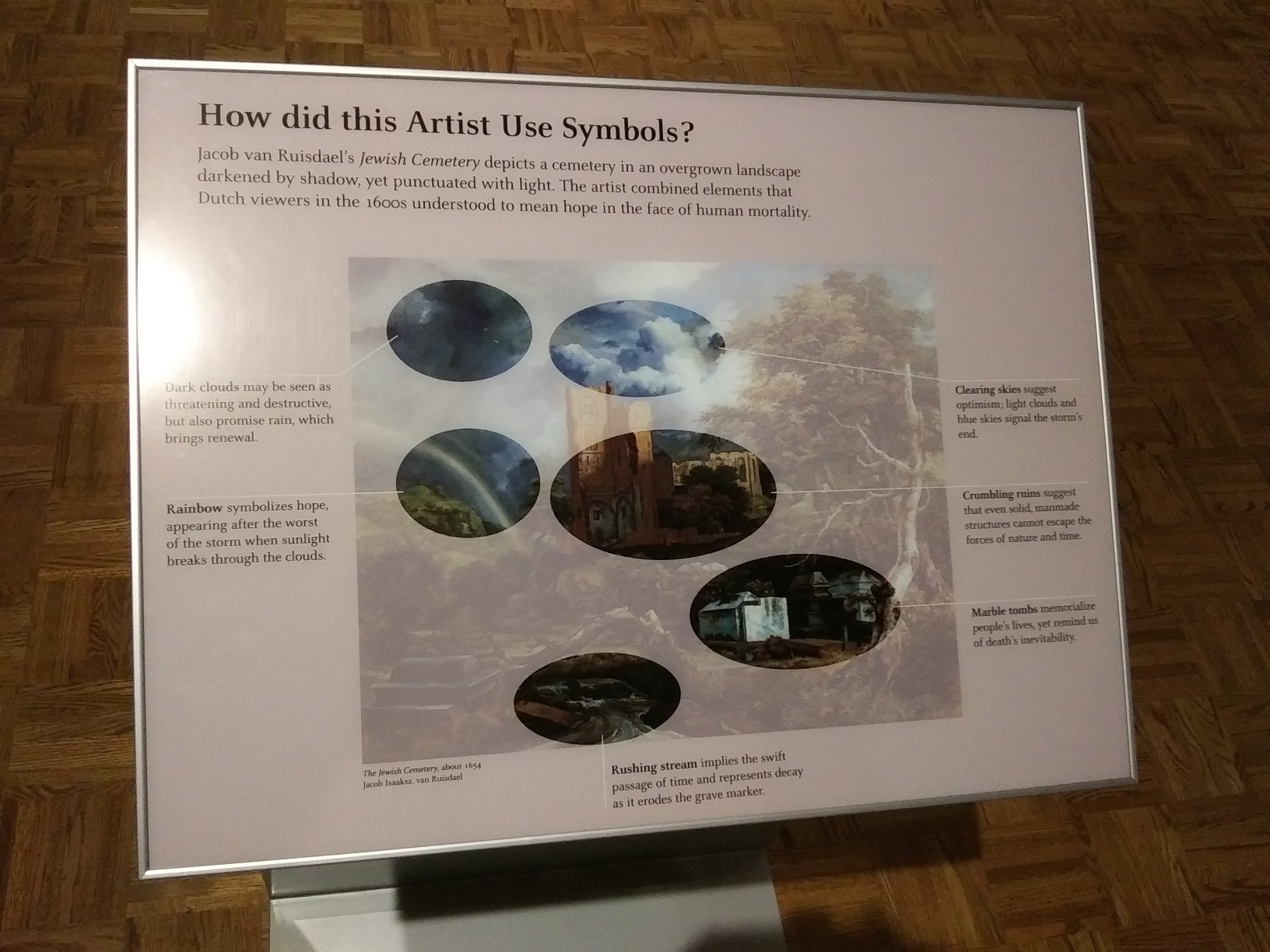
Of greater significance to the casual visitor are the handful of special explanatory panels that give a curator’s insight into a painting. To us, that’s just a landscape of a church and cemetery in a storm. Nice, but so what? The panel points out all the symbolism that the original audience would have spotted almost immediately.
Or you might get some technical information on “The Wedding Dance“ by Pieter Bruegel the Elder (e.g. that guy’s shirt was originally blue, but the paint faded over time and it’s now yellow).
There was even one painting where the artist died before he could finish “adjusting” it; the panel there pointed out all the little ways that things that look fine in the original sketch don’t always come out right in the final, larger work.
Just behind the DIA (if you’re looking at it from Woodward Avenue) is the Michigan Science Center.
As with almost every decent science museum these days, there are plenty of interactive exhibits explaining various scientific principles to kids that are very likely to be too young to understand or even care what is going on, along with staffers doing occasional demonstrations of things you don’t want to leave in the kid’s unsupervised hands.
Though to be fair, I chatted a bit with the staffer preparing the Rubens Tube about making science fun, and spent way too much time at the thing where you got to roll disks across a rotating turntable (which does have some interesting physics going on), and trying to fly a paper airplane through the hoops.
They were keeping up with some of the latest developments; one display was about nanotech and how things behave differently at really tiny scales.
There were also clear signs of corporate sponsorship. I suppose that really can’t be avoided. GM had its name on an “Earth, Wind, and Weather” gallery, where the displays showed how wind and weather changed the earth’s surface. That included an artificial geyser, where, if you had the patience and paid attention to the pressure and temperature gauges, you could learn how a geyser worked.
The largest exhibit had to have had some official sponsorship because it was just so strange and unexpected, but I didn’t notice any. A huge amount of space in the museum – so much that it arguably has to be a permanent display – was about asphalt and road paving. Seriously. I do maintain that everything can be interesting, but this was pushing it.

Different types of roads in different places call for different pavement types! Who’d have thought?
I didn’t find anything on the environment of the Great Lakes, or the geology of the state. Maybe that’s in a different museum.
Probably not in the Detroit Historical Museum, which happens to be across Woodward Avenue from the DIA.
Unfortunately, one of the exhibits I wanted to see (on the history of the area in pre- and early colonial times) was closed; they might have been changing out the exhibit in that gallery. Oh well. The huge exhibit on the Kresge Foundation’s centennial was obviously bought and paid for by the company. If you somehow didn’t know it was there, mass transit was covered with banners reminding you. Ugh. I breezed through it as quickly as I could.
Of far more interest was the exhibit on Detroit’s Brewing Heritage. Also worth spending time in is the “The Allesee Gallery of Culture”, which looks at the city in the 20th century, with lots of stuff on popular culture. It’s a HUGE space, to give them room to display signs and memorabilia collected from around the city – the sorts of things that locals would remember more than visitors; the stuff that makes up the ‘character’ of a city.

Like local horror host Sir Graves Ghastly.
There were the expected galleries with exhibits on the automotive industry and Detroit’s musical legacy – but also a large gallery that integrated actual rescued building facades into a “street” to show the city’s growth from a small town based on the fur trade to an industrial giant. There was also a gallery on Detroit’s role in WWII, with displays on life in the city during the war. I enjoyed the copy of a local paper; it’s cool to see what else was newsworthy enough to deserve a spot on the front page (the Warsaw Uprising, in this case).

Spoiler: Hal White did not get the win.
Being a short boat ride away from Canada, Detroit was a “terminal” on the Underground Railroad. So naturally, that was the focus of another gallery. The final display there answered a question that I don’t recall anyone (even me!) having asked before: What did the former slaves do now that they were in Canada?

Quite a few decided to settle in Canada permanently.
Speaking of Things I Did Not Know, you all know about the massive civil unrest, riots, protests, demonstrations, etc. that roiled the country (including Detroit) in 1968, right? Well, the summer before, Detroit had a riot that put all that to shame – if that’s the right word. Words are important here, as one of the displays in the gallery recounting the events mentioned. The violence was too widespread for a mere riot; could you call it an uprising, rebellion, or insurrection? Whatever you call it, it began with an attempt to shut down an unlicensed bar in the early morning hours of July 23 – and ended nearly a week later after tanks had rolled through the streets. It was mass urban violence that hadn’t been seen since the 1863 Civil War Draft Riots in New York City, and wouldn’t be seen again until the Rodney King Riots in Los Angeles in 1992.
It was an amazing exhibit, with lots of photos and oral histories. I’m glad I didn’t have to live through it.
After pondering something like that, the only thing to do is to stroll along the riverfront.
Which I will do next time, as I wrap up my visit.
 Pure Blather