I didn’t follow them that closely – as you can tell from the previous and subsequent posts, I was distracted. But I did catch a couple of events, and keep an eye on the press articles.
Paris and France did a great job with everything; I didn’t hear of any real complaints. The few that were made – like the quality of the water in the Seine – were the sorts that come with trying to put on an extravaganza at that scale.
“Scandals” of the sort that seem to pop up every time at the Olympics were mostly absent this year. I saw nothing about cheating or biased officials. Maybe I just wasn’t paying attention, but let’s instead go with the belief that everything on the fields of competition was honest, fair, and above-board. Such griping as there was had more to do with a perhaps too strict enforcement of the rules than from people trying to evade them.
There are always a couple of competitions that make you go “WTF? THAT is a Sport?” Usually, I reserve those comments for things that have the term “synchronized” in their names. This year, for reasons known only to them, they added break dancing….excuse me, “breaking”. Well, the organizers are allowed to add a few events as “demonstration” sports. One has to hope they won’t get crazy with adding events; the Olympics are expensive enough as it is.
Whatever happens, I hope they can keep some of the weirder sports.
Like race walking:
Race walking endures at the Olympics, and it’s more hip than you think
Its athletes have heard all the jokes, but don’t laugh: It’s a grueling test of endurance and technique, and Americans haven’t won an Olympic medal in the sport for 52 years.
“Okay, race walking is weird — but it is fun weird,” says Abrahamson, who is covering his 13th Olympiad. “And one of the things about the Olympics that people have to embrace is fun weird. Dull weird is boring, and dull weird needs to get out of the Olympics.” (What’s an example of a dull-weird event? Says Abrahamson: “I am not going there on the record.”)
Here’s the thing about the Olympics: Many of these sports are weird, if you stop and think. Synchronized diving: Why? Why not! And the pole vault: What on Earth? More like what off Earth, right? (Do not email me; I respect all sports; I’m proving a point.) So the race walk is not weirder than any other Olympic sport.
And steeplechase:
What’s the toughest event in the Olympics? How about the 3,000 meter Steeplechase?
Her sport requires elite endurance, for all those meters that must be run. Competitors must be athletic, to go over the barriers; physically tough, to withstand inevitable pain; mentally fortified, to focus while still doing everything else. Otherwise, they’ll land in photographs that live forever: bodies upside down, heads about to hit both water and track.
This race is one of track’s most unpredictable, most strategic and least understood. For fans of Olympic competition, extreme sport enthusiasts or anyone who simply loves watching anything crash, steeplechase is the sport for you. It’s time to Embrace the Chase, where track meets distance running meets pile-ups in car accidents meets Game of Thrones-level masochism.
Every Olympics has its share of great moments, many of which happen when you’re not looking. This one’s pride of place belongs to Cuban wrestling legend Mijaín “El Terrible” López Núñez winning his fifth straight gold medal in Greco-Roman wrestling (130kg division). Five straight medals in the same individual event. Think about it. Katie Ledecky has yet to do it. Michael Phelps didn’t do it. Carl Lewis didn’t do it. Al Oerter didn’t do it….
And then he announced his retirement in the way that many wrestlers do: by taking his shoes off and leaving them on the mat, daring someone to come along and fill them.

Click to go to the YouTube video
Speaking of great moments, it’s always awesome to see someone winning a first-ever medal for their home countries.
Saint Lucia – Julien Aflred, Women’s 100m Sprint (Gold)
Dominica – Thea LaFond, Women’s Triple Jump (Gold)
Cabo Verde – David de Pina, Men’s Boxing, 51kg (Bronze)
Or when you don’t have a country:
Refugee Olympians – Cindy Ngamba, Women’s Boxing, 75kg (Bronze)
I’m not going to get into any arguments about which of these was Albania’s first medal:
Islam Dudaev, Men’s freestyle wrestling 65kg (Bronze)
Chermen Valiev, Men’s Freestyle 74kg (Bronze)
Your country may have won medals before, but this is their first Gold:
Botswana – Letsile Tebogo, Men’s 200m Sprint
Guatemala – Adriana Ruano, Women’s Trap Shooting
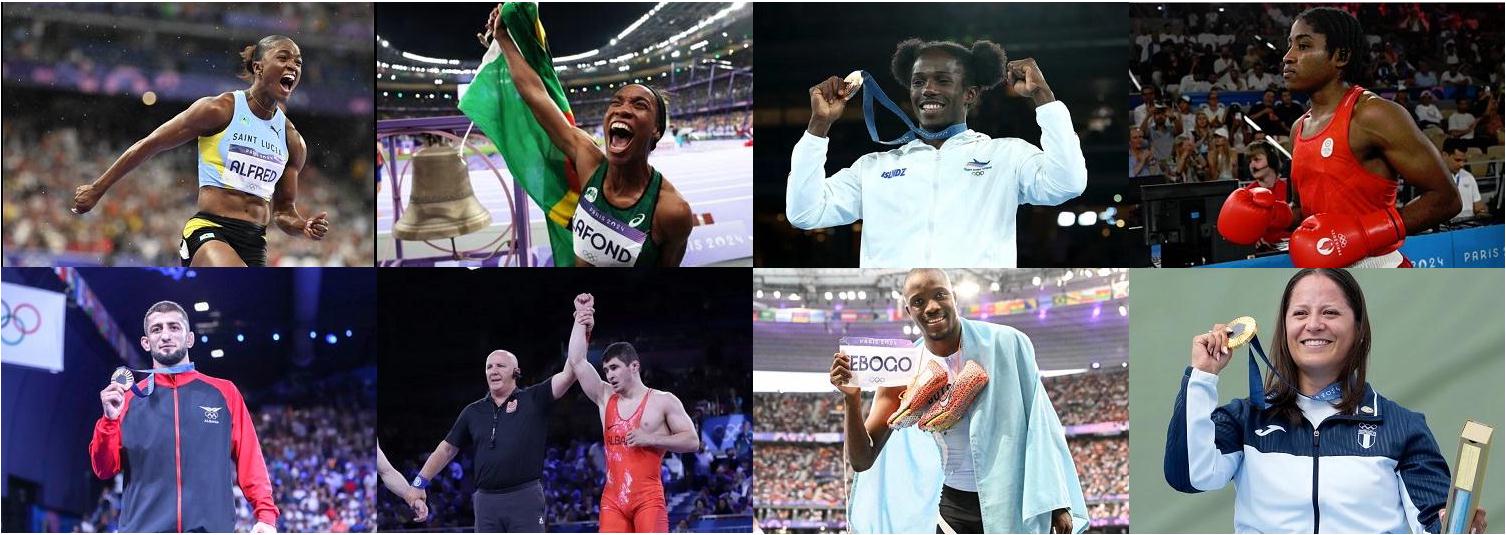
Top, L to R: Alfred, LaFond, De Pina, Ngamba.
Bottom, L to R: Dudaev, Valiev, Tebogo, Ruana.
There are about 70 countries still waiting for that honor. The reasons come down to small size (not enough talent to draw on), poverty (it costs money to train athletes to be able to compete at this level), an “unstable” government (you need to have your act together before you can meet the IOC’s requirements to participate), or some combination of the three. Small countries can focus on those competitions that don’t get much attention from the bigger ones and poor countries can get support from the IOC’s various “scholarship” programs. There’s not much that can be done if your government is in constant turmoil. You can always keep sending athletes to carry your flag with pride, and hope that some year you get lucky – even if that “luck” means some reporter seeks you out to ask you how you got here, and what you hope to accomplish.
For the record, the athletes that were their country’s sole representative in Paris are Winzar Kakiouea of Nauru, Romano Puentener of Liechtenstein, Ali Idow Hassan of Somalia, and Shaun Gill of Belize.
We admire the athletes who pull off spectacular athletic achievements and make it look easy. We should also take a moment to admire these athletes who make it look incredibly, incredibly hard. They’ve worked and fought for their painful moments on the Olympic stage in ways runners and swimmers from more competitive countries might not have. And they did it without the allure of potentially winning: They did it just to say they did it….
The Marshall Islands needed a sprinter and [Richson Simeon] was that sprinter. They told him all he needed to do was try. Whether he performed well or poorly, he still fulfilled his job of ensuring the country had somebody, anybody, on the track in Rio. You could even argue that his slowness was a boon: Because he finished last, more journalists like me talked to him, learned his story, and helped tell the world about the Marshall Islands….
…This story started with a runner who finished in last place in a meet in Sacramento, and ended with a sprinter who finished in last place in Rio. The only differences are the time it took him to finish, and the stage he did it on.
And to Simeon, those two things mean everything.
“I just ran my personal best at the Olympics,” Simeon says. “I don’t even have words.”
 Pure Blather